


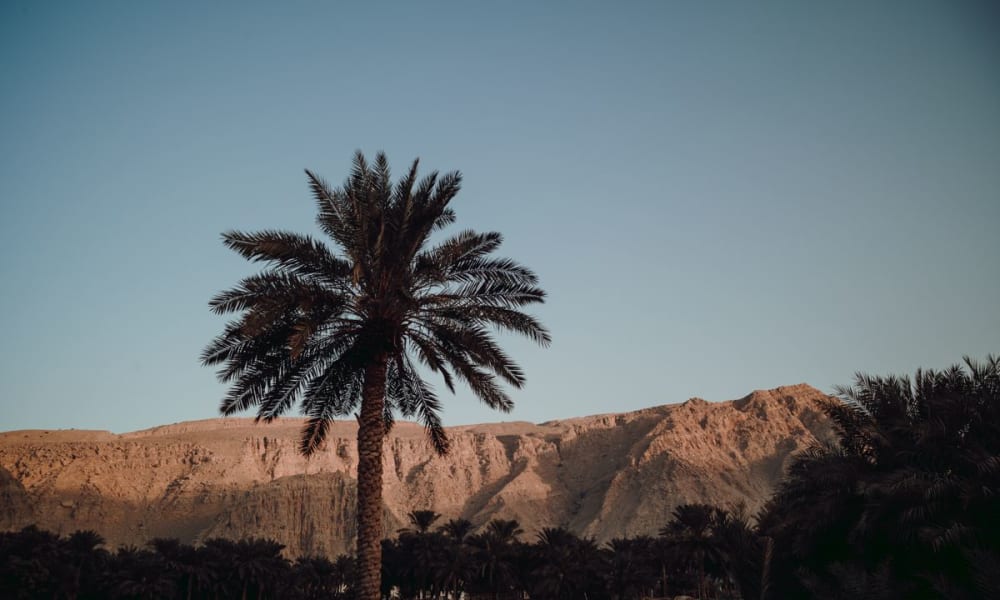
Mountains in Musandam
Mountains in Musandam

The coastline of Musandam characteristic appearance is thanks to the limestone mountain range that rises there. No other region in Oman is as primitive, untouched, and natural as the mountainous world in Musandam. Those who set out to discover this mountainous world will find steep slopes, breathtaking gorges, dreamy small beaches, and overwhelming cliffs. The whole area is complemented by a few hotels in the mountain regions, which offer not only an excellent adventure holiday but also a wide range of options for families.
By car from Khasab to Ras al Kaimah
Anyone wishing to explore the mountains by car has a lot to discover on the approximately 70-kilometer-long route from Khasab to Ras al Kaimah in the United Arab Emirates. The areas where the mountain road becomes a coastal road are particularly stunning. It runs directly along the flank of a cliff that steeply descends into the sea beside the road. From here, there are unique views of secluded bays and beautiful beaches that seem to cling closely to the rocky coast and can only be reached by boat.
The As Sayh Plateau – a paradise in the mountains
Those seeking their very own paradise in the mountains of Musandam are recommended to drive from Khasab to Jebel Harim. At 2087 meters, it is the highest mountain in the mountain region of Musandam. However, at an altitude of 1100 meters, visitors are in for a real surprise. About 15 kilometers from the summit of Jebel Harim, one arrives at a paradisiacal plateau – the As Sayh Plateau. Amidst the rugged mountain world of Jebel Harim, the green expanse with date palms and almond trees appears strangely surreal. The plateau is predominantly populated by goats that satisfy their hunger on the lush meadows of the plateau. However, at 1600 meters, the journey ends. Military restricted area begins there. However, the view from up here is definitely worth a trip to the mountainous region.
Discover Oman with experts who have called it their home
Your dream holiday, tailor-made by experts.
We don't just know Oman from books, we visit the country several times a year to experience the culture, landscape and people first-hand.
From your first enquiry to your return home, we are there for you personally - by phone, email or WhatsApp, whenever you need us. Our trips are as unique as you are: individually planned and provided with exclusive privileges and high-quality arrangements that will make your trip unforgettable.
Experts for your Oman trip


You might also like this

Oman’s Landscapes
Oman stands out with its incredible natural diversity, setting itself apart from many other Arab countries. Far from the stereotype of endless desert landscapes, Oman offers a surprising blend of majestic mountains, vast sand dunes, turquoise coastlines, and lush, fertile plains. Spanning over 309,500 square kilometers, the country boasts natural wonders from the towering peaks of the Hajar Mountains to the tropical regions of Dhofar in the south. Oman is especially captivating for independent travelers seeking unique encounters with nature. Northern gems like Jabal Shams, the expansive deser...

Currency in Oman
Are you planning a trip to Oman and wondering how the currency works? Here you will find all the important information about the currency in Oman, the Omani Rial (RO), and how you can best exchange money....

Oil, Gas, and Industry in Oman
Oil and gas are the two industries that still account for the largest part of the Omani gross domestic product. It was around 51% in 2013. This leads to the fact that still around 85% of state revenues come from the sale of oil and gas, which in turn leads to an enormous dependence on factors such as oil prices and the global demand for oil and gas. Coupled with the fact that Oman is a country that has comparatively few oil reserves that can be extracted without significant technical and financial effort, this poses a mammoth task for the political leadership. For relying solely on oil and gas...